

Essay regarding the Sudan conflict and its international implications regarding the R2P. Written by Valeria Castro Piqueras. Images taken out from Pinterest.
The Responsibility to Protect (R2P) emerged from a fundamental principle of international law: states have a responsibility to protect their populations from the gravest forms of violence. Yet the war in Sudan raises a difficult question about how effective this responsibility really is when the state itself becomes one of the main perpetrators of violence.
Since April 2023, Sudan has been consumed by a devastating conflict between the Sudanese Armed Forces (SAF), led by General Abdel Fattah al-Burhan, and the Rapid Support Forces (RSF), a paramilitary organization commanded by General Mohamed Hamdan Dagalo, known as Hemedti. What began as a struggle for political and military power has evolved into a complex war characterized by mass displacement, famine, ethnic violence and widespread human rights abuses. In Western Darfur, the scale of the violence has been described as reaching the level of genocide.
The situation poses a direct challenge to the credibility of R2P. Despite the existence of an international framework designed precisely to prevent mass atrocities, the international community has struggled to provide an effective response. The Sudanese case therefore illustrates not simply a failure to intervene, but a deeper problem within the contemporary international system: what happens when those responsible for protecting civilians become perpetrators themselves, while external powers pursue competing geopolitical interests?
R2P and the failure of state protection
The Responsibility to Protect is built around three pillars. The first establishes the responsibility of the state to protect its population from four mass atrocity crimes: genocide, war crimes, crimes against humanity and ethnic cleansing. The second places responsibility on the international community to assist states in fulfilling this obligation. The third allows the international community to take appropriate action when a state is manifestly failing to protect its population.
The first pillar has effectively collapsed because neither of the principal belligerents have been able or willing to protect the civilian population. Instead, both the SAF and RSF have been accused of serious violations of international humanitarian law and human rights. The conflict has resulted in mass killings, forced displacement, famine and the recruitment of children. Estimates cited in the report suggest that tens of thousands of people have been killed since 2023, while millions have been internally displaced or forced to flee the country.
The problem becomes even more complex because the conflict is no longer simply a confrontation between two centralized forces, since a growing number of ethnic militias, Popular Resistance Forces and shifting alliances have become involved. This fragmentation makes it increasingly difficult to identify a single authority capable of negotiating on behalf of the combatants or to establish clear chains of accountability. Sudan therefore exposes one of the central limitations of R2P: its implementation depends, to a significant extent, on political will. International law can establish responsibilities, but enforcing them becomes considerably more difficult when state institutions are fragmented and armed groups operate outside a unified command structure.
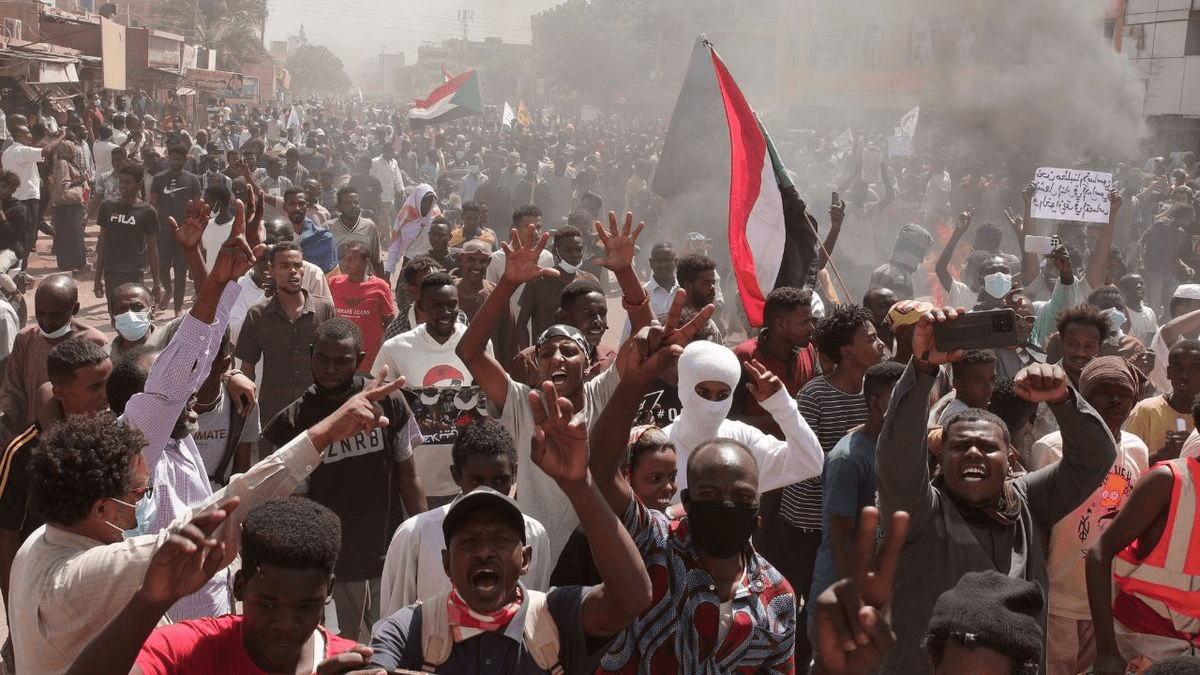
A conflict shaped beyond Sudan's borders
Since the beginning of the war, both the SAF and RSF have sought external allies, military supplies and financial support from countries such as Egypt and Saudi Arabia supporting the SAF, and others such as the United Arab Emirates or Uganda aligning with the RSF, each pursuing their own interests. This external involvement has transformed Sudan's war into more than a domestic power struggle. Competing regional interests have made mediation increasingly difficult and have weakened attempts to establish a unified political settlement. Rather than reducing the capacity for violence, international involvement has in many cases helped sustain it by trying to benefit from it.
This directly undermines the third pillar of R2P, which depends on the international community's ability to take collective action when states fail to protect their populations. Mediation efforts have repeatedly stalled, and at the same time, divisions within the United Nations Security Council have limited the international community's ability to respond collectively. The use of veto power to protect strategic interests illustrates a broader structural weakness, where institutions designed to respond to international crises can themselves become paralysed by geopolitical competition.
The result is a paradox at the heart of the international system. The more international actors become involved in Sudan, the more difficult it becomes to achieve a common response, since strategic interests increasingly take precedence over civilian protection, while the mechanisms intended to uphold international law struggle to overcome political divisions. Sudan therefore raises a broader question about whether traditional approaches to peacebuilding remain adequate for contemporary conflicts, considering that modern wars are increasingly characterized by decentralized armed groups, foreign intervention, shifting alliances and forms of hybrid warfare.
For this reason, the international community should move from a reactive approach towards a stronger system of prevention and early warning. The United Nations Human Rights Council (UNHRC) should strengthen mechanisms capable of identifying emerging risks of mass atrocities before violence reaches its most destructive stage. Early warning should be accompanied by the political capacity to act quickly once those risks are identified, and international actors should work to ensure that those responsible for atrocities face meaningful consequences, rather than allowing political fragmentation to become a mechanism for avoiding responsibility.
Yet perhaps the most important element of any sustainable solution is the inclusion of Sudanese civil society. Peace cannot be built exclusively through negotiations between military actors or imposed by external powers. Sudanese civil society and movements such as the Resistance Committees should be treated as central participants in the peace process. Their involvement is essential not only for representing civilian interests, but also for ensuring that any future political settlement reflects the needs of the population itself.
Rethinking R2P in an era of fragmented conflict
Sudan's crisis is not simply a case in which the international community failed to recognize the scale of the atrocities, the problem lies in the fragmentation of political and military power, the transformation of state actors into perpetrators and the involvement of external powers pursuing competing strategic interests. These dynamics have weakened each of the three pillars of R2P and left civilians exposed to systematic violence, displacement and famine.
The Sudanese case therefore calls for more than another attempt at mediation. It demands a reconsideration of how international institutions respond to conflicts in which there is no single authority capable of protecting civilians and where foreign actors actively contribute to the continuation of violence. If R2P is to remain a credible principle of international law, it must adapt to this new face of conflict. Prevention, early warning, accountability, the restriction of external military support and the meaningful participation of civil society should become central to international responses.
Ultimately, Sudan demonstrates that the existence of an international legal responsibility does not necessarily guarantee its enforcement. The promise of R2P can only be fulfilled when international institutions are capable of placing civilian protection above geopolitical competition. Otherwise, Sudan risks becoming another example of the growing gap between the principles of the international system and its capacity to protect those who need it most.
Bibliography
Pichon, E. (2025). Understanding the war in Sudan. [online] European Parliament. EPRS - European Parliamentary Research Service.
Nyadera, Dr. I.N. (2024). The Sudan Crisis and Failure of the Responsibility to Protect Doctrine. [online] Australian Institute of International Affairs.
Getachew Birru, J. (2024). Foreign meddling and fragmentation fuel the war in Sudan. [online] ACLED.


